
RIFT SPORTS · COURT PLANNING · EAST AFRICA
What does it cost to build a padel court in East Africa?
As a starting point, Rift Sports typically budgets approximately US$30,000–US$40,000 per outdoor padel court for the projects we scope, including the court structure, a suitable concrete foundation and usual installation work. The final figure depends on your location, site conditions, court specification and delivery arrangements.
This is Rift's experience-based planning range—not a fixed quotation, a published regional market average or a guaranteed all-inclusive price. Before committing, confirm exactly how freight, inland transport, import duties and taxes, specialist unloading, lighting and electrical connections, additional drainage and site works are treated in your project quote. A roof, canopy, building or significant ground remediation can change the budget considerably.
If you are planning courts for a hotel, school, sports club or property development in Uganda, Kenya, Tanzania or Rwanda, the most useful question is not simply “What does the court cost?” but “What will it cost to have this particular court ready to play at my site?”
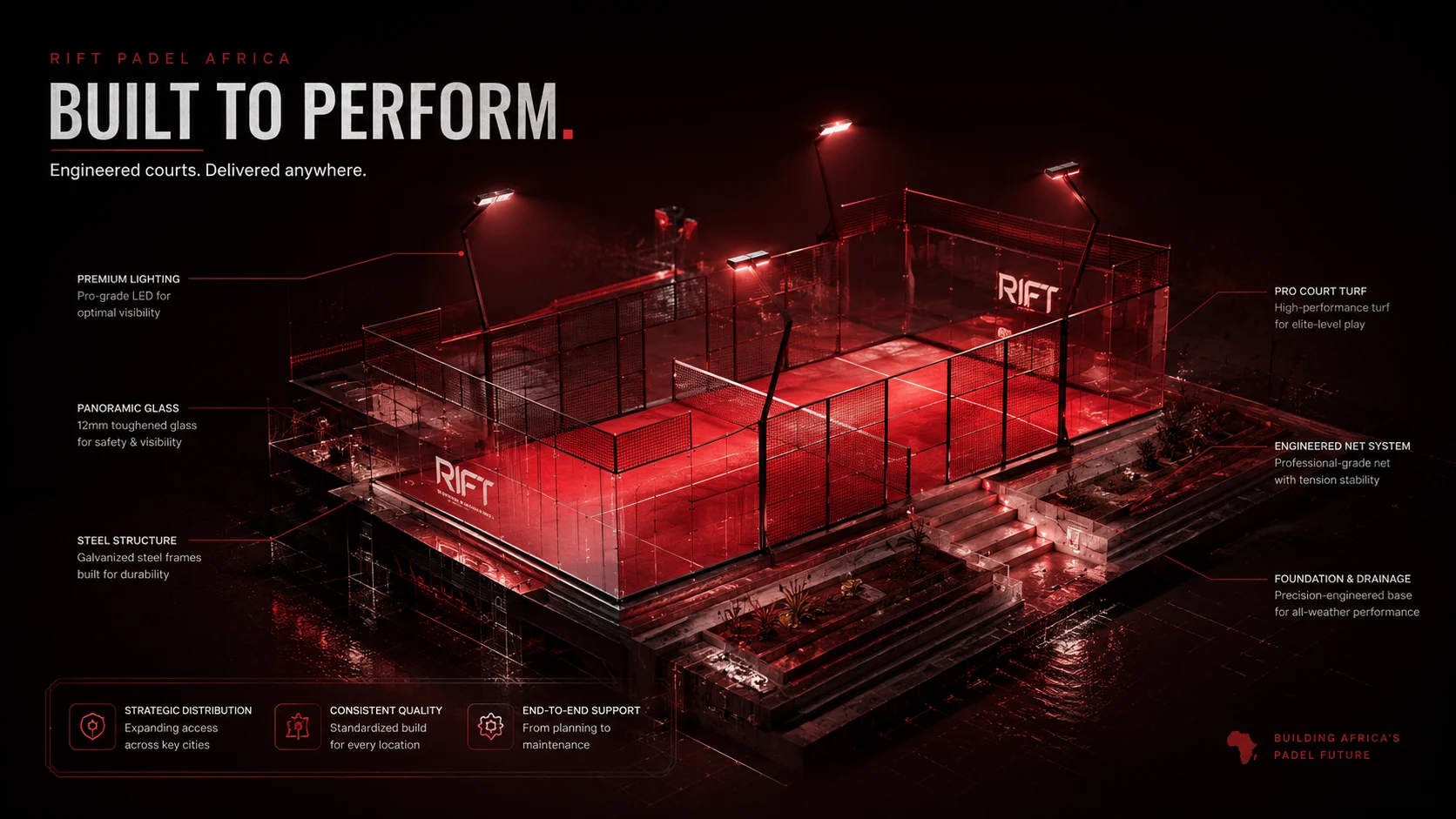
What does the US$30,000–US$40,000 starting range include?
Our initial budgeting conversation considers more than the imported kit. A useful project budget should identify the court structure and components, the locally designed base or foundation, and the work required to install the court safely. The amount attributable to each part varies from project to project.
Questions to settle before comparing quotations
| Cost area | What you should confirm |
|---|---|
| Court equipment | Which model, steel structure, glass, turf, net, lighting and accessories are included? Are the specifications and warranties documented? |
| Foundation and civil works | Who supplies the local design, excavation, reinforcement, concrete, drainage and any required ground preparation? What assumptions were used? |
| International transport | Is the quote ex-works, FOB, CFR or CIF? What container type is specified, and where does the quoted freight end? |
| Port, customs and inland delivery | Who handles clearance, local duties and taxes, port and terminal charges, container movement and delivery to the actual site? |
| Installation and handover | Are the installation crew, travel, accommodation, lifting equipment, assembly, inspections and handover included? |
| Site-specific extras | Are electricity, access routes, canopy, indoor building, difficult groundworks, extra drainage and additional amenities separately priced? |
For multiple courts, ask for a combined site budget as well as a per-court breakdown. Shared works, freight and mobilisation costs do not necessarily scale in a straight line with the number of courts.
One East African cost people often overlook: shipping
Imported padel courts are not always shipped like ordinary retail goods. Depending on the manufacturer's packing plan, court components can require 40-foot open-top shipping containers instead of regular enclosed dry containers. In Rift's own supplier planning for dismantled Spanish-made courts, 40-foot open-top containers have been specified for the route through the Port of Mombasa and onward to Uganda.
Why does that matter? An open-top container can allow components to be loaded from above, but it introduces different equipment availability, lifting and handling requirements. Depending on the cargo's packed dimensions, the shipping line may classify the shipment as in-gauge or out-of-gauge; an open-top container does not automatically mean the load is out-of-gauge. The shipping quotation and terminal arrangements must match the actual loaded dimensions and weight. [5]
For East African projects, the total logistics plan may involve the exporting factory, the port of departure, sea freight to Mombasa or another suitable gateway, customs or transit documentation, onward road delivery and finally offloading at the venue. Glass panels and coated steel components also need proper packing, securing and damage checks.
We recommend asking your supplier and clearing partner these questions before placing an order:
- What container type is required? Request a packing list with dimensions and weights rather than assuming a standard 40-foot dry container.
- Where does the freight quotation stop? “CFR Mombasa” is not the same as delivery and unloading in Kampala, Arusha or Kigali.
- What happens at the port? Confirm handling, clearance and potential storage, detention or demurrage exposure with the logistics provider.
- Can the site receive and unload it? Check road access and arrange suitable lifting equipment before the container arrives.
- Who carries the risk at each stage? Clarify insurance, responsibility for damage and what happens if components are missing.
Rift's practical advice: treat shipping, customs and final delivery as a defined workstream, not a footnote below the court price. The exact import requirements and taxes need to be confirmed for the destination country and the actual shipment.
Why can two seemingly identical courts have different prices?
A flat-looking plot is not necessarily ready for a padel court. Soil conditions, existing levels, drainage, access and the availability of electricity can materially affect the civil works. Technical construction guidance recommends checking the site and designing foundations for its actual conditions, rather than relying on a universal slab detail. [3]
There is also an important difference between an outdoor court and a covered or fully indoor project. A canopy or building needs its own structural, drainage, access and electrical scope. Near the coast, corrosion protection and maintenance provisions are particularly worth confirming against the chosen manufacturer's specification and warranty. [4]
How much land does one court need?
The International Padel Federation specifies an internal playing area of 20 metres by 10 metres—200 square metres. That is the playing space, not a guarantee that any 200 m² plot will accommodate the complete facility. Allow for the court enclosure and the access, circulation and installation requirements of your chosen site. [2]
Send a measured sketch, site photographs, nearby building locations and an indication of how a delivery vehicle would reach the plot. These details can reveal costly constraints while the plan is still flexible.
How to compare quotations fairly
Ask all suppliers to quote against the same court model, destination and agreed division of responsibilities. Use a simple comparison table with three columns for each item: included, excluded and to be confirmed. Never treat an omitted cost as zero.
- Check the exact equipment specification and written warranty conditions.
- Separate the foundation and other local civil works from the imported equipment price.
- Confirm the shipping container type and the delivery point named in the quote.
- Assign responsibility for taxes, customs, offloading and installation.
- Check payment stages, exchange-rate exposure, lead times and what must be ready before installation.
For projects at schools and hotels, also decide early who will manage access, player bookings, maintenance and daily operations. Rift can discuss club-management and booking software alongside the physical facility, with supported features confirmed for your venue.
What should you send Rift for an initial estimate?
You do not need a complete architectural package to start a conversation. The following is usually enough to establish the next practical step:
- Country, town and site location.
- Number of proposed courts and preferred court type.
- Approximate measured area, photographs and details of existing surfaces.
- Whether the project is outdoor, covered or inside a building.
- What is known about drainage, electricity and truck or crane access.
- Intended users—members, hotel guests, students or the public—and your target opening period.
Rift helps clients assess padel court planning, equipment sourcing and installation coordination in East Africa. We can work with you to clarify the scope, identify assumptions and build a quotation around the actual location and intended use.
Discuss your padel court project ↗
Sources and how to use this guide
These references support the dimensions, technical and freight-planning advice. They do not establish Rift's own US$30,000–US$40,000 indicative planning figure, which comes from our project experience and requires a site-specific written quotation. UK guidance is not a substitute for local engineering, approvals, import or tax advice.
- LTA, Padel Court Construction Guidance Note — distinguishes court systems from civil and facility costs.
- International Padel Federation, Rules of Padel — internal court dimensions.
- SAPCA, Code of Practice for Padel Courts — site investigation and civil works.
- JUBOpadel, Quality Standards — manufacturer-specific materials and protective treatments.
- Maersk, Special Cargo — open-top equipment, in-gauge and out-of-gauge distinctions.